Your Brain on Alcohol: How Much is Too Much?
Home / Blog /
If you’ve kept up with your readings – meaning our blogs – you’ll recognize the term “brain shrinkers.” However, if you’re new to our posts and thus have no clue what a brain shrinker is, no worries, I’ll give you the gist. Brain shrinkers – what I’ll refer to as “shrinkers” moving forward – consist of anything that cause your brain to shrink over time. This includes psychological disorders such as depression and anxiety, chronic stress, lifestyle habits such as poor diet choices, lack of physical activity, drug and alcohol abuse, insomnia, so on and so forth. And while I could spend this time discussing why and how each shrinker damages your beautiful brain, I’m not going to do that. Instead, we’re going to talk about the one shrinker that’s most intoxicating. You know the one – booze.
Before you fall down the proverbial rabbit hole and start worrying that I’m going to tell you to stop drinking altogether, wait to hear what I have to say. Frankly, I don’t care about the single glass of wine that you have with dinner a few times a week. Even moderate alcohol consumption, defined by the Center for Disease Control (CDC) as one to two drinks (which can be one or two of a) 12 oz. beer with 5% alcohol; b) 8 oz. malt liquor with 7% alcohol; c) 5 oz. wine with 12% alcohol; d) 1.5 oz. of 80-proof with 40% alcohol) per evening is not cause for serious concern, although some research has shown that it can increase a woman’s likelihood of developing breast cancer by 0.55% over the course of her lifetime. What I’m most concerned about, however, is a pattern of heavy alcohol use. No, that one night two weeks ago when you drank five or more alcoholic beverages on a single occasion (i.e., binge drinking) does not qualify. However, if you’re a man consuming 15 or more drinks in a week, or a woman consuming eight or more drinks in a week, that’s cause for concern.
Your Body on Alcohol
So, what happens when you drink? Well, as you down your first beer, that liquid gold is absorbed through your stomach lining into your bloodstream, followed by diffusion into your body’s tissues. After 20 minutes, your liver starts to metabolize the alcohol; one ounce every hour. So, if you drink until your blood alcohol content (BAC) reaches the legal limit (0.08), it’ll take about five and a half hours to leave your body. While the amount of time it takes to expel the alcohol from your system does not vary widely from person to person, several factors do effect BAC and the amount of time it takes to reach the legal limit.
Factors that affect absorption and tolerance:
Biological Sex: Dehydrogenase, the enzyme that breaks down alcohol in your tummy, is lower in women than in men. So, if Jill and her buddy Joe drink the same amount in the same amount of time, Jill will have a higher BAC.
Hormones: They impact your body’s ability to process alcohol. Drinking the same amount of alcohol during menstruation will result in higher BAC.
Body Fat/Weight: Women usually have greater percentages of body fat and lower percentages of water compared to their male counterparts. So, even if Ann and Dave weigh the same, Ann will likely achieve a higher BAC at a faster rate.
Your Brain on Alcohol
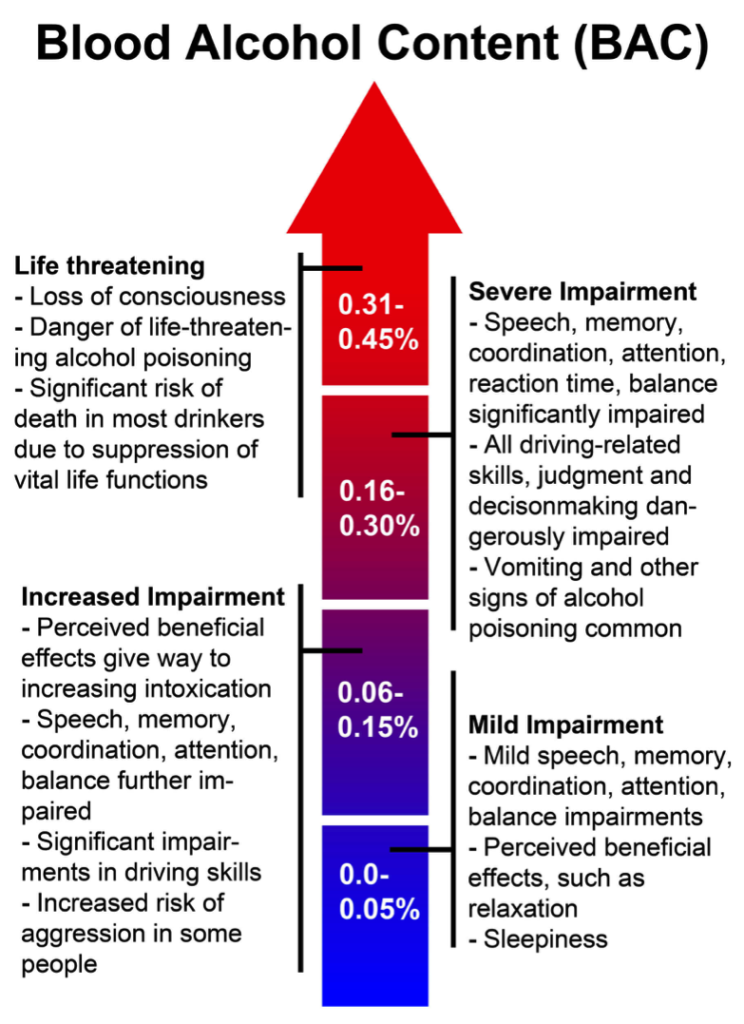
It takes roughly five minutes for alcohol to reach your brain and 10 minutes for you to notice behavioral/emotional changes. You know that feeling of euphoria that you get within several minutes of starting to drink? Yeah, that’s normal, it happens during the early stages. Subsequent stages of alcohol consumption include depression and disorientation (0.05 BAC), excitement (0.09-0.25), and confusion (0.18-0.3), to name a few; increase in BAC gives rise to new feelings and behaviors.
As I’m sure you know, drinking impacts several regions of the brain. When you’ve reached the “excitement” stage and are experiencing slurred speech, blurred vision, feelings of impulsivity, and loss of fine motor skills, that’s a result of your frontal, occipital, temporal, and parietal lobes being affected. If we’re being technical, what’s really happening is alteration of neuron membranes, enzymes, ion channels, and receptors. What’s important for you to know is that moderate drinking and rare binges won’t have any long-term effects on your brain. As Dr. Fotuhi states in his book “Boost Your Brain,” “drink no alcohol and your brain will experience the usual degradation that happens with age; drink some and you’ll see reduced damage; drink too much and injury to the brain shoots through the roof.”

That brings me to the topic of long-term brain damage. As I’m sure you’ve heard before, alcohol abuse kills brain cells. The areas impacted the most include your cerebellum, cortex, and hippocampus, the areas responsible for hand-eye coordination, balance, decision-making, and general task and cognitive performance. Abuse of alcohol also damages myelin (i.e., the protective coat around the axon of the neuron; the highway that enables chemical messages to get from one neuron to another), which results in severe nerve damage. Some alcoholics may even develop a disorder called Wernicke-Korsakoff syndrome, a disease that causes vision, coordination, walking, memory, and learning impairments.
Reminders:
–You can drink, just don’t overdo it. One glass of wine with dinner won’t do you any harm, but if you’re a male having more than 15 drinks within a week, or a female having more than eight drinks within a week, that’s way too much.
–Be nice to your liver. Remember, the liver starts to metabolize drinks after one hour. If you drink until your BAC reaches the legal limit, it’ll take around five and a half hours to completely expel it from your body.
–Different factors affect BAC. If you’re a female and you’re drinking with your male friend, remember that you will achieve a higher BAC in a shorter amount of time – blame higher percentage of body fat, hormones, and dehydrogenase levels!
-You drink too much, but you don’t know what your next step should be. Contact the National Drug and Alcohol Treatment Referral Routing Service, available at 1-800-662-HELP. You’re not alone. Don’t be afraid to ask for help.
If you want to learn more about the effects of alcohol on the body or brain and how you can improve your brain function, check out Dr. Fotuhi’s Brain Fitness Program at mfotuha.maktechaccessories.com/.
This blog was written by Brianna Sirkis and edited by Dr. Majid Fotuhi.
References:
Alcohol’s Effect on Brain and Behavior
Factors that Affect How Alcohol is Absorbed and Metabolized
More Articles
You Can Get Smarter. Neuroscience Proves It.
I want to start with something I hear almost every week, from patients, from students, from some of the most accomplished people I know.
“I’m just not as smart as other people.”
Sometimes it comes out directly, like that. More often it arrives dressed in other language. Someone describes a co-worker who always has the answer in the meeting. A sibling who seems to grasp ideas without effort. A friend who navigates social situations with a ease they can’t replicate. And beneath all of it, the same quiet conclusion: some people are just built differently. Some people got more of whatever “it” is.
Once, a teenage patient came to see me with her mother because she felt she would never be as smart as her older sister. She was getting A’s in every subject except math and physics. She loved drawing, writing, singing, and acting — she was the star of her school’s theater group — but in her mind, none of that counted. She couldn’t understand the equations. And in her world, that meant she wasn’t smart.
I want to tell you what I told her. And I want to explain the neuroscience behind it, because this is not a motivational speech. This is biology.
What Intelligence Actually Is
When we talk about the brain and higher-level thinking, we often confuse three words that mean very different things: cognitive skills, talents, and intelligence.
Cognitive skills are the higher brain functions you use every day — reading, writing, navigating a conversation, doing your taxes, following a recipe. Talents are cognitive skills that go one step further: playing a musical instrument, excelling at a sport, writing beautifully, creating visual art. And intelligence simply means doing any of these cognitive skills at an exceptionally high level.
Here is what neuroscience tells us about all three: they are the result of networks of neurons connecting and firing in two parts of your brain — the cortex and the hippocampus. The cortex is the outer layer of your brain, and the hippocampus is an extension of the cortex that sits deep inside your temporal lobe, roughly the size of your thumb. Together, they form the biological foundation for everything you think, learn, and remember.
And what is the most important thing I can tell you about those structures?
They are highly malleable. They can change. They change for the better every single time you use them. When you challenge them by doing something difficult — something genuinely unfamiliar and demanding — you make them grow larger and stronger. They are, in the most literal neurological sense, like your muscles. The more you challenge them, the larger and stronger they get.
There Are 30 Forms of Intelligence — Not Two
In my book, The Invincible Brain, I describe 30 different forms of intelligence. Not two. Not the handful that get tested on standardized exams. Thirty.
There is emotional intelligence — your ability to perceive and manage feelings in yourself and others. Social intelligence — your ability to connect with almost anyone in any room. There is body movement and dexterity intelligence. Musical intelligence. Cooking intelligence. Humor intelligence — yes, being a genuinely funny person is a form of intelligence, and a sophisticated one at that. There is navigational intelligence, digital intelligence, street-smart intelligence, happiness intelligence, and many more.
My point is not simply that the definition of intelligence is broader than we thought. My point is that the way we have been measuring and talking about intelligence — in schools, in workplaces, in the way we size each other up — has been systematically wrong. We have taken two or three narrow cognitive domains, elevated them above everything else, and allowed millions of people to walk away from childhood and adolescence believing they came up short.
My teenage patient had extraordinary intelligence for visual art, narrative writing, performance, and musical expression. Her cortex and hippocampus had grown and specialized to be exceptional in those areas. They had not, yet, been challenged enough in math and physics. But that was not a fixed condition. It was a starting point.
The Patient Who Scored in the 99th Percentile
After I explained to her the malleability of the cortex and hippocampus — that these structures change every time they are challenged, and that she could genuinely become excellent at math and physics if she committed to challenging them — something shifted.
She had been telling herself a story. A story that said: I am not the kind of person who is good at this. That story was not just discouraging. At a neurological level, it was an active obstacle, because it was removing the effort and practice that growth requires. Once she stopped believing the ceiling was fixed, she began working as though it wasn’t.
With some tutoring support and consistent daily practice, she improved steadily. And when she sat for her SAT exam, she scored in the 99th percentile — meaning she had performed exceptionally well across every dimension of that test, including the mathematical sections she had once believed were beyond her.
She had not discovered hidden talent she never knew was there. She had built it. That is what the brain does when you give it the right conditions.
Intelligence Is Not Fixed
I want to be as clear as possible on this point, because it runs counter to a very deep cultural assumption: intelligence is not fixed. Not at 16, not at 45, not at 70.
Every part of your cortex and hippocampus can grow stronger with practice. The science is unambiguous on this. The more you use your brain — the more you engage it in genuinely challenging, unfamiliar work — the more those neuronal networks consolidate and expand. You can acquire any talent you wish to have. There is no ceiling imposed by biology. The only ceiling that is real is the one built from a belief that the ceiling is real.
We should never tell our children they are not good at something. And we should stop telling ourselves that, too.
Five Steps to Become One Notch Smarter in Three Months
I want to give you something concrete. Not a philosophy — a method. Five steps that, practiced with genuine commitment over ninety days, will make you measurably better in any field you choose. Not the best in the world. One notch better than you are today. Which is all it ever takes.
Step 1: Shift the narrative in your head. You have to genuinely believe — not just tell yourself — that you can get better at almost anything. Because you can. The science is on your side. Every story you carry about what you’re “just not good at” is a story about where you haven’t practiced yet, not about what your brain is capable of.
Step 2: Make a list. Write down the things you would love to be good at. Dancing. Chess. Math. Cooking. Public speaking. Remembering names. Learning a language. Whatever genuinely excites you — not what impresses other people. Just make your list and be honest about it.
Step 3: Choose one. From that list, identify the one skill or hobby that would bring the most joy to your life if you became genuinely good at it. The one you feel most passionate about. Decide on that single thing. Focus matters here — the brain builds its networks through repetition of a specific demand, not through scattered effort across a dozen things simultaneously.
Step 4: Practice it every day — even for a few minutes. Take a class. Watch a YouTube series. Find a mentor. But whatever you do, touch it daily. You don’t need hours. You don’t need a perfect structure. You need to challenge that specific part of your cortex and hippocampus consistently enough that those neuronal networks have a reason to consolidate. Your only goal is to be slightly better than you were yesterday.
Step 5: Be persistent — and be proud of your mistakes. This step matters more than any of the others. Three months of consistent practice, even modest practice, will produce measurable change in the brain. That is not a promise — that is what the MRI shows. But persistence is the prerequisite.
And here is something I want you to hold onto: every time you make a mistake in the process of learning something difficult, you are among the rare few who had the courage to step outside their comfort zone. Most people don’t do that. Most people stay comfortable and tell themselves they’re not as capable as others. You’re different. Give yourself credit for that.
What 40 Years of Studying the Brain Has Taught Me
I have spent nearly four decades studying the brain, mostly at Johns Hopkins and Harvard Medical School. I have treated thousands of patients across a very wide range of cognitive conditions — from children with attention challenges to adults in the early stages of Alzheimer’s. And the one thing I know with certainty, after all of that research and all of those patients, is this:
Your brain has far more capacity than you have ever used. It is far more intelligent than you think it is.
Every day you choose to challenge it — in any domain, at any level — you are making that foundation larger and stronger. And every day you tell yourself the story that you’ve already reached your ceiling, you are choosing not to.
Start today. Just one notch. Just try to be slightly better at one thing than you were yesterday.
In three months, you will be much, much better than you are today.
Dr. Majid Fotuhi is a Harvard- and Johns Hopkins-trained neurologist, bestselling author of The Invincible Brain (USA TODAY Bestseller), and one of the world’s leading experts on brain health and cognitive performance. To discover your brain health score and receive a personalized 10-page report, take the free Invincible Brain Assessment at invincible.drfotuhi.com.
Don't Let Artificial Intelligence Steal Your Intelligence
I want to start with a warning. Not about artificial intelligence itself — but about what happens to your brain when you stop doing the things AI can now do for you.
I have spent nearly four decades studying the human brain, first at Johns Hopkins and then at Harvard Medical School, and the single most dangerous misconception I encounter — in patients, in students, in the brightest people I know — is the belief that the brain is like a computer. That it arrives at its peak somewhere in early adulthood, runs well for a while, and then inevitably begins to slow.
That is simply not true. And in the age of AI, it is a misconception with consequences we are only beginning to understand.
Your Brain Is Not a Computer
A computer is a fixed system. You can upgrade its parts, expand its memory, replace its components — but its fundamental architecture does not change in response to how it is used. The brain does exactly the opposite.
Your brain is a living organ. At a microscopic level, it is changing right now — building new connections, reinforcing pathways that are used, and allowing pathways that are neglected to quietly weaken. This is not a metaphor. This is the biology.
There is a structure deep inside your brain called the hippocampus. It is roughly the size of your thumb, tucked at the base of the temporal lobe, and it is the engine of your memory and learning. What the science shows with clarity is this: the hippocampus grows when it is challenged, and it shrinks when it is not.
London taxi drivers who spend years memorizing every street and shortcut in one of the most complex urban environments on Earth have measurably larger hippocampi than average. The same has been documented in people who learn a new language, master a musical instrument, or take on demanding cognitive tasks that require navigating genuine uncertainty.
Use it, and it grows. Neglect it, and it atrophies.
That is not a figure of speech. That is what the MRI shows.
The Two Ways to Use AI
I am not here to tell you that AI is dangerous. It is not — not inherently. And it is not going away. We are living through the most remarkable technological revolution in human history, and I believe AI will continue to grow more powerful, more capable, and more integrated into how we work and live.
But there are two fundamentally different ways to engage with it — and they have opposite effects on your brain.
The first way is to use AI as a thinking partner. You engage with it to explore a subject more deeply, to process vast amounts of information, to pressure-test your own reasoning, to evaluate what is true and what is not. In this mode, your brain is working. You are bringing your own knowledge, your own judgment, and your own curiosity to the interaction. Your hippocampus is engaged. This kind of use is healthy.
The second way is to use AI as a substitute for thinking. You ask it to write the email you could have written yourself. You ask it for directions before you leave, instead of making even a partial attempt to recall the route. You let it summarize the article rather than reading it carefully and formulating your own understanding. In this mode, your brain is bypassed — not extended. And every time it is bypassed, the mental muscle that would have done that work gets a little weaker.
None of these individual shortcuts feel consequential. That is precisely what makes them worth paying attention to.
What I Do Personally
I want to be transparent about something. Everything I am about to share with you, I do not prescribe from a distance. I practice it myself — as an experiment I am running on my own brain.
I memorize phone numbers. I memorize credit card numbers. I make a deliberate point of learning the names of everyone I meet — the bank teller, the waiter, the colleague I just crossed paths with at a conference. None of this takes extraordinary effort. But each of these small acts requires my brain to encode, hold, and retrieve information rather than outsourcing that work to a device.
I deliberately skip GPS when I already know, or can reasonably figure out, how to get somewhere. When I write — whether it is a paper, a talk, or a message — I write first, and then I ask AI to critique what I have written. Not the other way around.
And I dance once a week with my wife.
I mention dancing specifically because I want you to understand what is happening in the brain during that hour. You are listening to music and tracking rhythm, which activates the auditory and motor cortices simultaneously. You are coordinating movement with another person, which requires continuous social and spatial processing. You are staying present and responsive to what your partner is doing in real time. You are navigating physical space. The brain does not experience this as recreation. It experiences it as one of the most complex, multi-layered demands you can place on it. Neuroscience loves that kind of demand.
The broader point is simple: there are opportunities to exercise your brain woven into every day. The question is whether you take them, or whether you hand them to AI.
What I See in the Clinic
Every day, I meet patients in their fifties and sixties who are frightened. Their memory is slipping in ways that feel new. Their thinking feels slower. They come in wanting to know whether what they are experiencing is the beginning of Alzheimer’s, or something else — something that might be reversible.
What I tell them, backed by research and by the results of my clinical experience treating thousands of patients, is this: your brain has not given up on you. But you may have given up on your brain.
Prevention is not a pill. It is a practice. It is a daily decision to challenge yourself rather than to offload the challenge. To be curious rather than comfortable. To make your brain work for the answer rather than reaching for something that will retrieve it instantly.
The research is clear on what works: aerobic exercise triggers the growth of new brain cells in the hippocampus. Deep sleep activates the glymphatic system, which clears the toxic proteins associated with Alzheimer’s. Stress management protects the hippocampus from the long-term damage of cortisol. Nutritional strategies — particularly the Mediterranean and MIND diets — have been shown to meaningfully reduce the risk of cognitive decline. And cognitive training, the kind that is genuinely challenging rather than merely familiar, builds the neural reserve that protects your brain as it ages.
These are not luxury habits for people with extra time. They are the practices that determine what kind of brain you are living in at seventy, at eighty, at ninety.
The Most Transformative Technology You Already Own
AI will keep improving. It will become more capable. It will continue to offer to do things that your brain used to have to do itself. And there will always be a case for letting it — in the right context, for the right tasks.
But here is what no algorithm can replicate: the feeling of solving a hard problem and finding your way through it. The satisfaction of remembering something you worked hard to learn. The confidence that comes with a mind that has been trained, stretched, and trusted.
Your brain is not a relic of a pre-AI world. It is your greatest asset. And unlike every device you own, it does not become obsolete with use. It becomes more powerful every time you demand something of it.
So make the demand — every day. Learn something new. Memorize something that feels unnecessary. Write the email yourself. Take the route without the GPS. Dance. Engage. Challenge.
The most transformative technology available to you is not in your pocket. It has been with you since the day you were born.
Protect it. Train it. Trust it.
The more you use it, the stronger it gets.
Dr. Majid Fotuhi is a Harvard- and Johns Hopkins-trained neurologist, bestselling author of The Invincible Brain*, and one of the world’s leading experts on brain health and cognitive performance. To discover your brain health score and receive a personalized 10-page report, take the free Invincible Brain Assessment at invincible.drfotuhi.com.
Your Brain on Stress
Stress levels are on the rise in America. While stress affects your day-to-day quality of life, it can also create a host of health conditions and impact your brain both structurally and functionally. In order to prevent this damage, it is important to understand the connection between your brain and stress. what stress is actually doing to your brain.
When you experience stress, the brain triggers the release of a hormone called cortisol into your bloodstream. Small amounts of cortisol can help you focus and take action in a high pressure situation; for example, you can function better when you sit down to take a test or when you meet a not-so-friendly bear on your camping trip. However, too much cortisol can shrink the brain, damage your memory capacity, and impair communication between different regions of the brain.
Damage to Memory
In a particularly stressful time of life, you may have more trouble remembering your doctor’s appointment or where you left your car keys. This is because stress directly impacts short term memory and can inhibit your ability to make long term memories. Studies show that even mild exposures to stress before a memory retention test result in worse scores. Research also shows that individuals with higher levels of cortisol had smaller hippocampi – the region of your brain that is critical for learning and memory. This is because stress can kill brain cells and make it harder for new neurons to survive. If you have fewer neurons in your hippocampus, your memory function will decline and over time you will have a higher risk for developing Alzheimer’s disease. Too much stress can erase the benefits of lifestyle factors that have been shown to be helpful for better cognitive performance and longevity (factors such as eating healthier, exercising, learning new skills, and sleeping well).
Damage to Executive Function
Not only does stress make it harder for you to remember the name of the coworker you just met, researchers found that individuals who experience chronic stress, have less gray matter (or brain volume) in their prefrontal cortexes. This region of the brain right behind your eyes is important for tasks such as planning, decision making, problem solving, self-control, and emotion regulation. This could explain why you experience more frequent mood swings, or why making a simple decision may feel more difficult during periods of high stress.
Damage to Communication
High levels of cortisol in the bloodstream, especially for long periods of time, can shrink and impair several areas of the brain. But stress can also change how the different brain regions communicate with each other. New research has found that chronic stress can result in the abnormal overproduction of myelin; a fatty substance that helps speed up the transmission of electrical signals between neurons.
Too much myelin can disrupt the brain’s sensitive balance of communication. Studies found that in people who developed PTSD, excess cortisol from stressful experiences led to an excess of myelin. The excess production of myelin may have strengthened the connection between the part of the brain responsible for learning and memory (the hippocampus) and the part responsible for fight-or-flight responses (the amygdala). A faster connection between these two areas can result in stronger fear responses to a given situation. These findings suggest that increased cortisol may make it more likely for someone to develop depression, PTSD, or other mental disorders because the excess myelin disrupted the brain’s normal communication patterns. This new area of neuroscience research suggests that when it comes to the brain, too much of a good thing – high levels of myelin and stronger connections — can potentially do more harm than good.
While reading this article, you may have felt your own stress levels rise as you learned about the negative impacts of stress. However, because of something called neuroplasticity, the brain has an incredible capacity to bounce back and repair itself. Introducing a few routines in your day-to-day life such as meditation, exercise, and getting the proper amount of sleep can significantly reduce your cortisol levels and protect your brain from the effects of stress. The good news is that a just few simple practices can significantly boost the level of neuroplasticity in your brain and make you feel calmer and happier.
If you’re interested in learning more about improving your brain function and memory, please visit us at www.neurogrow.com.
This blog was written by Lizzie Lewis, and edited by Dr. Majid Fotuhi.