Dr. Majid Fotuhi

Your Brain on Alcohol: How Much is Too Much?

Home / Blog /

Your Brain on Alcohol: How Much is Too Much?

If you’ve kept up with your readings – meaning our blogs – you’ll recognize the term “brain shrinkers.” However, if you’re new to our posts and thus have no clue what a brain shrinker is, no worries, I’ll give you the gist. Brain shrinkers – what I’ll refer to as “shrinkers” moving forward – consist of anything that cause your brain to shrink over time. This includes psychological disorders such as depression and anxiety, chronic stress, lifestyle habits such as poor diet choices, lack of physical activity, drug and alcohol abuse, insomnia, so on and so forth. And while I could spend this time discussing why and how each shrinker damages your beautiful brain, I’m not going to do that. Instead, we’re going to talk about the one shrinker that’s most intoxicating. You know the one – booze.

Before you fall down the proverbial rabbit hole and start worrying that I’m going to tell you to stop drinking altogether, wait to hear what I have to say. Frankly, I don’t care about the single glass of wine that you have with dinner a few times a week. Even moderate alcohol consumption, defined by the Center for Disease Control (CDC) as one to two drinks (which can be one or two of  a) 12 oz. beer with 5% alcohol; b) 8 oz. malt liquor with 7% alcohol; c) 5 oz. wine with 12% alcohol; d) 1.5 oz. of 80-proof with 40% alcohol) per evening is not cause for serious concern, although some research has shown that it can increase a woman’s likelihood of developing breast cancer by 0.55% over the course of her lifetime. What I’m most concerned about, however, is a pattern of heavy alcohol use. No, that one night two weeks ago when you drank five or more alcoholic beverages on a single occasion (i.e., binge drinking) does not qualify. However, if you’re a man consuming 15 or more drinks in a week, or a woman consuming eight or more drinks in a week, that’s cause for concern.Description: A close up of a glass Description automatically generated

Your Body on Alcohol

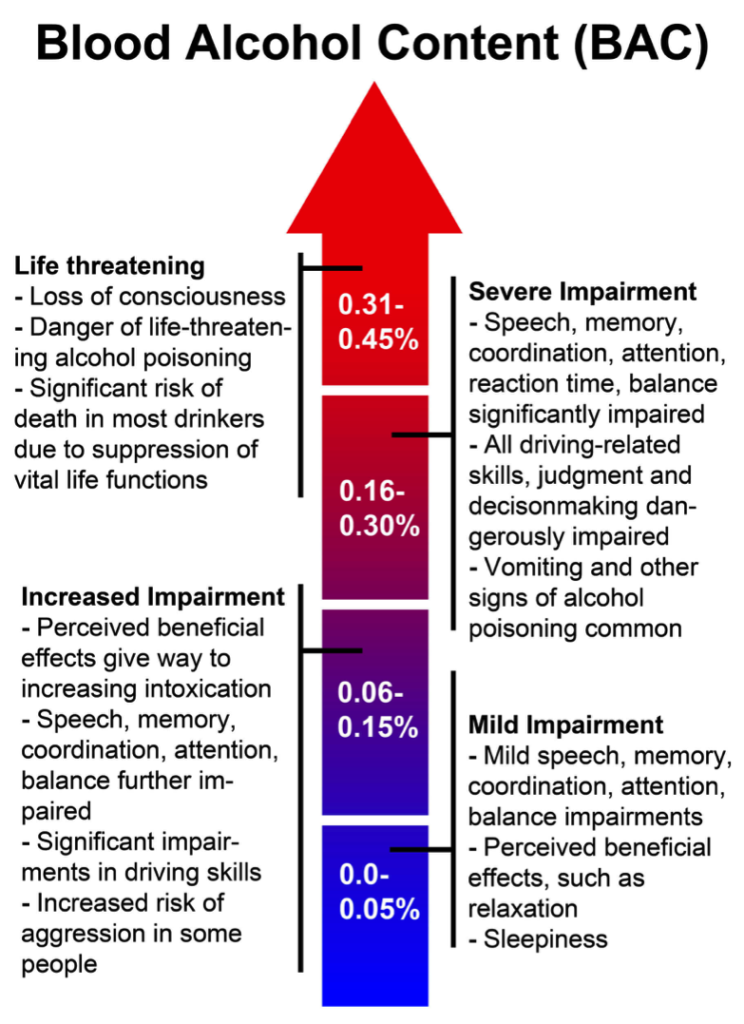
So, what happens when you drink? Well, as you down your first beer, that liquid gold is absorbed through your stomach lining into your bloodstream, followed by diffusion into your body’s tissues. After 20 minutes, your liver starts to metabolize the alcohol; one ounce every hour. So, if you drink until your blood alcohol content (BAC) reaches the legal limit (0.08), it’ll take about five and a half hours to leave your body. While the amount of time it takes to expel the alcohol from your system does not vary widely from person to person, several factors do effect BAC and the amount of time it takes to reach the legal limit.

Factors that affect absorption and tolerance:

Biological Sex: Dehydrogenase, the enzyme that breaks down alcohol in your tummy, is lower in women than in men. So, if Jill and her buddy Joe drink the same amount in the same amount of time, Jill will have a higher BAC.
Description: A screenshot of text Description automatically generated

Hormones: They impact your body’s ability to process alcohol. Drinking the same amount of alcohol during menstruation will result in higher BAC.

Body Fat/Weight: Women usually have greater percentages of body fat and lower percentages of water compared to their male counterparts. So, even if Ann and Dave weigh the same, Ann will likely achieve a higher BAC at a faster rate.

Your Brain on Alcohol

It takes roughly five minutes for alcohol to reach your brain and 10 minutes for you to notice behavioral/emotional changes. You know that feeling of euphoria that you get within several minutes of starting to drink? Yeah, that’s normal, it happens during the early stages. Subsequent stages of alcohol consumption include depression and disorientation (0.05 BAC), excitement (0.09-0.25), and confusion (0.18-0.3), to name a few; increase in BAC gives rise to new feelings and behaviors.

As I’m sure you know, drinking impacts several regions of the brain. When you’ve reached the “excitement” stage and are experiencing slurred speech, blurred vision, feelings of impulsivity, and loss of fine motor skills, that’s a result of your frontal, occipital, temporal, and parietal lobes being affected. If we’re being technical, what’s really happening is alteration of neuron membranes, enzymes, ion channels, and receptors. What’s important for you to know is that moderate drinking and rare binges won’t have any long-term effects on your brain. As Dr. Fotuhi states in his book “Boost Your Brain,” “drink no alcohol and your brain will experience the usual degradation that happens with age; drink some and you’ll see reduced damage; drink too much and injury to the brain shoots through the roof.”

Description: A picture containing animal Description automatically generated

That brings me to the topic of long-term brain damage. As I’m sure you’ve heard before, alcohol abuse kills brain cells. The areas impacted the most include your cerebellum, cortex, and hippocampus, the areas responsible for hand-eye coordination, balance, decision-making, and general task and cognitive performance. Abuse of alcohol also damages myelin (i.e., the protective coat around the axon of the neuron; the highway that enables chemical messages to get from one neuron to another), which results in severe nerve damage. Some alcoholics may even develop a disorder called Wernicke-Korsakoff syndrome, a disease that causes vision, coordination, walking, memory, and learning impairments.

Reminders:

You can drink, just don’t overdo it. One glass of wine with dinner won’t do you any harm, but if you’re a male having more than 15 drinks within a week, or a female having more than eight drinks within a week, that’s way too much.

Be nice to your liver. Remember, the liver starts to metabolize drinks after one hour. If you drink until your BAC reaches the legal limit, it’ll take around five and a half hours to completely expel it from your body.

Different factors affect BAC. If you’re a female and you’re drinking with your male friend, remember that you will achieve a higher BAC in a shorter amount of time – blame higher percentage of body fat, hormones, and dehydrogenase levels!

-You drink too much, but you don’t know what your next step should be. Contact the National Drug and Alcohol Treatment Referral Routing Service, available at 1-800-662-HELP. You’re not alone. Don’t be afraid to ask for help.

If you want to learn more about the effects of alcohol on the body or brain and how you can improve your brain function, check out Dr. Fotuhi’s Brain Fitness Program at mfotuha.maktechaccessories.com/.

This blog was written by Brianna Sirkis and edited by Dr. Majid Fotuhi.

References:

How Alcohol Impacts the Brain

Alcohol’s Effect on Brain and Behavior

Alcohol and Public Health

This is Your Brain on Alcohol

Factors that Affect How Alcohol is Absorbed and Metabolized


More Articles

Your Brain Is a Portfolio: What Every Executive Should Know About Brain Aging

If you are an executive who works long hours and lives under a heavy load of stress, I want you to read this closely. I have some good news and some bad news about your brain. But first, let me tell you about a patient of mine.


He was a 49-year-old hedge fund manager. Over two years, he had become the most successful person at his firm and had been promoted twice. On the surface, everything was going right.


Underneath, though, he had started to notice changes. He was getting grumpy with his family more easily. He would forget the names of his own clients. During afternoon meetings, he would feel foggy and struggle to keep up with everyone else in the room. And because his father had struggled with dementia late in life, he had begun to fear this was the start of Alzheimer’s disease.


My first job was to figure out what was actually driving those changes.


The Belief That Holds Most Executives Back


Most high performers assume their mental sharpness will either hold up with age or slowly slip away, and that there is very little they can do about it. They picture the brain as a fixed structure, like a computer you cannot upgrade.


That is absolutely wrong.


Your brain is much more like a portfolio. It appreciates with the right investment. It depreciates with neglect. And either way, it is compounding, for better or worse, every single day.


A short temper, memory lapses, and afternoon fog are not signs of permanent damage. They are signals that your brain portfolio needs more attention. As my patient came to learn, these warning signs can be reversed.


The Bad News: How Your Routine May Be Shrinking Your Brain


Let me start with the bad news, because it matters.


Sustained stress keeps a hormone called cortisol elevated in your blood. Over time, elevated cortisol is linked to shrinkage in parts of your frontal lobes and your hippocampus, the very regions responsible for decision-making, executive function, leadership, learning, memory, and emotional regulation.


Think of chronic stress as an unhedged risk exposure. It sits quietly on your balance sheet, and if you never address it, it erodes the asset every single day it goes unmanaged.


Stress is not the only factor. A sedentary lifestyle, an irregular sleep pattern, a poor diet, and a lack of downtime and relaxation all shrink your cortex and hippocampus over time. And the more your brain atrophies, the worse you function, which, for a leader whose work depends on judgment, is the entire game.


The Good News: Atrophy Can Be Reversed


Now the good news, and it is substantial.


Based on compelling scientific evidence, atrophy in the frontal lobe and hippocampus can be reversed through what I call the five pillars of brain health.


Think of the five pillars as five separate investments in your brain. Each one alone is enough to make a real difference in your cognitive performance. But when you combine them, the returns do not just add up. They compound. Imagine what your brain will look like when all five are working for you at once.


1. Exercise: Aerobic activity, such as walking for an hour, raises levels of a molecule called BDNF, which actively supports growth in the brain. This is real capital appreciation on your brain asset, not vague wellness advice. It is one of the most direct and measurable levers available to you.


2. Sleep: Your brain has an innate cleanup operation called the glymphatic system, and it runs hardest during deep sleep, clearing out the metabolic waste that builds up during a normal day of thinking and working. Sleep fewer than six hours a night, and that clearance does not finish completely. Over time, the deficit compounds night after night, the same way unpaid interest compounds on a balance. Sleep is not rest for your brain. It is an active maintenance system that protects your principal.


3. Diet: What you eat becomes the literal building material for your brain cells. The Mediterranean diet, rich in olive oil, leafy greens, fish, nuts, and berries, supplies the omega-3 fatty acids and antioxidants that calm the inflammation eroding neurons over time. Think of it as the raw material you feed into the factory. Even the best machinery produces poor output if the inputs are poor.


4. Stress regulation. This is trainable, not a personality trait, and it functions as your hedge. Something as simple as breathing slowly for two minutes has real benefits for your brain, both in the short term and the long term.


5. Novelty and cognitive challenge. Brains that keep learning something genuinely new build what is called cognitive reserve, a protective buffer that makes the whole portfolio more resilient to future stress or decline.


Where to Start: Rebalance Your Weakest Position


Now comes the most important question. What can you do right now, in the shortest amount of time, to see the best results?


Pick the one lever that is the weakest position in your portfolio, and work on it for two weeks.


If it is sleep, look for the underlying causes and make fixing it a priority. You really do not want insomnia quietly shrinking your brain and compounding over time in a way that could raise your risk for Alzheimer’s disease.


If it is stress, build a system to reduce it by ten percent over the next two weeks. Make a list of what matters most in your life, and eliminate one or two responsibilities that matter least. You are a smart person; figure out what needs to change so you can have some calm, relaxing time in your day. Try breathing slowly for two minutes, without interruption, at least once a day. Do it when you feel overwhelmed, or right before you fall asleep.


What Happened to the Hedge Fund Manager


Let me return to my patient for a moment.


Once I walked him through what was actually driving his brain changes, he had a genuine aha moment. He decided to cut back on his hours. He realized that his family and his own life mattered more to him than getting promoted at an accelerated pace. That one shift changed everything.


After six weeks of working on all five pillars of brain health, he was calmer, happier, and sharper. In fact, he stopped worrying about Alzheimer’s disease altogether.


Your Brain Is the Asset Everything Else Depends On


Here is what I want you to take from this.


Your brain is the one asset that every other asset in your life depends on. Everything else you optimize sits downstream of it. Start managing your brain like the highest ROI investment you have, and you will notice the difference within weeks, not years.


I believe what separates a good leader from a great leader is how they care for their company and their people while also caring for themselves and their own brains. Sacrificing your wellbeing to drive company revenue takes a toll on brain vitality and accelerates decline in the prefrontal cortex and hippocampus, the very regions essential for making decisions under pressure, and for memory and learning.


Build the five pillars into your daily routine as much as you can, and you will notice a clear improvement in your brain function within weeks.


Dr. Majid Fotuhi is a Harvard- and Johns Hopkins-trained neurologist, bestselling author of The Invincible Brain (USA TODAY Bestseller), and one of the world’s leading experts on brain health and cognitive performance. He has spent more than three decades studying the brain’s capacity for growth and repair. To discover your brain health score and receive a personalized 10-page report, take the free Invincible Brain Assessment at invincible.drfotuhi.com.


📺 Watch the full video on Dr. Fotuhi’s YouTube Channel.


Keep up with Dr. Fotuhi on LinkedIn & Instagram.

Your Knees and Your Brain Want the Same Five Things

Here is something surprising about the link between your knees and your brain: the same five habits that keep your knees from wearing out are the ones that keep your brain from wearing out.


But here is the part that surprised even me, after forty years in neurology. Knee pain that goes untreated does not stay in the knee. It can quietly trigger the start of accelerated brain aging. Pain leads you to slow down, and inactivity speeds up cognitive decline faster than almost anything else.


That chain reaction from a sore knee to a fading brain is what I want to walk you through. And I am going to show you exactly how to stop it and reverse it, so you can become more mobile and regain your brain vitality at the same time.


Different Tissue, Same Fire


Why would your knees and your brain care about the same things? Because they share the same enemy: chronic, low-grade inflammation.


In your joints, that inflammation breaks down cartilage. In your brain, that same inflammatory process contributes to significant atrophy and cognitive decline. Different tissue, same fire.


This is the key insight, and it changes how you should think about your health. The habits that put out the inflammatory fire don’t protect one organ or the other. They protect both at the same time.


The Five Pillars for Your Knees and Your Brain


Let me walk you through the five pillars that are essential for your knees and your brain, whether your joints are perfectly healthy or already hurting.


Pillar one: Exercise: Movement nourishes your cartilage and increases blood flow to your brain. Aim for 3,000 to 7,000 steps a day. That is just walking, not a serious workout. If you have the time, add some vigorous exercise for about three hours a week.


Pillar two: Diet: Eat fatty fish like salmon or sardines twice a week. Snack on fruit, such as a cup of blueberries. Avoid junk food, cook at home as much as possible, and use extra virgin olive oil instead of other oils. You can also take an omega-3 supplement with DHA and EPA at a dose of 1,000 mg a day. Curcumin is another great anti-inflammatory supplement worth trying. These food choices calm inflammation in your joints and your brain at once.


Pillar three: Sleep: Sleep seven to eight hours, and pay attention to when you go to bed, not just how long you sleep. Late, irregular sleep raises joint inflammation and disrupts your brain’s overnight clean-up process.


Pillar four: Weight and Metabolic health: Even a modest amount of weight loss meaningfully reduces the inflammatory load on both your joints and your brain. You do not need to lose a lot to feel a real difference.


Pillar five: stress reduction: A daily five-to-ten-minute practice of meditation or slow, deliberate breathing lowers the same inflammatory markers that damage cartilage and neurons alike.


Five daily habits. Two organs protected at once.


The Trap That Catches So Many People


Now I want to speak directly to anyone who has untreated knee osteoarthritis, because this is the moment that decides everything.

When your knee hurts, every instinct tells you to protect it by moving less. I understand that instinct. But moving less is exactly how you fall into a trap of accelerated cognitive decline. A slow, sedentary lifestyle leads to brain atrophy and a rapid decline in thinking and memory.


I have watched this happen to patients again and again. And I have also watched it reverse. Let me tell you about two of them.


Janet: When Treating the Knee Treated the Brain


I remember a patient of mine named Janet vividly. A retired teacher, she was 69 when she came to see me, worried about developing Alzheimer’s disease.


During our conversation, she mentioned in passing that she had significant pain in her left knee. As a result, she had stopped going to her pickleball games. She had also quietly withdrawn from other activities she used to love, like dancing.


I referred her to a physical therapist, who put her on a knee strengthening and stabilization program. She did it religiously, every day, for three months.


The woman who came back to see me was not just walking better. Janet was animated again, and she felt sharper. Most of her sense of cognitive decline had come from her sedentary life and her social isolation. Treating her knee pain, in a very real sense, treated her brain.


Jack: A Conversation About the Brain, Not the Knee


Another patient, Jack, was a 75-year-old accountant. He came to see me worried about “losing his marbles.”


As we talked about his overall health, I learned that he had lived with severe knee arthritis for years. Slowly, he had pulled back from his friends, his hobbies, the life he used to have. His sedentary lifestyle had led to gaining thirty pounds. His mood had darkened, and his memory was slipping.


He had tried physical therapy, but the pain persisted. His knee MRI showed advanced arthritis, and his surgeon recommended a knee replacement. But Jack refused. He wanted nothing to do with surgery.


So we talked- not about his knee, but about his brain. About how movement protects against cognitive decline, and how staying sedentary was quietly raising his risk of Alzheimer’s. That conversation changed his mind, and he agreed to the surgery.

Three months later, Jack was walking two to three miles a day. He was happier. He was sharper. And he told me, with real excitement in his voice, that he felt like he was starting an entirely new chapter of his life.


Don’t Let Pain Shrink Your Life


I share these two stories because they are not the exception. They are what happens when you refuse to let joint pain shrink your life.


Treat it aggressively. Set a goal to stay strong and active, not just to manage pain quietly in the background. Do not let anything stand between you and an active lifestyle.


Protecting your knees is not separate from protecting your brain. They both need the same five things: exercise, anti-inflammatory foods like a Mediterranean diet, adequate sleep, a healthy weight, and a calm mind.


And if your knees are already hurting, do not let that pain become the quiet beginning of accelerated aging. Strengthen them, treat them seriously, and stay in the life you have built.


Dr. Majid Fotuhi is a Harvard- and Johns Hopkins-trained neurologist, bestselling author of The Invincible Brain (USA TODAY Bestseller), and one of the world’s leading experts on brain health and cognitive performance. He has spent more than three decades studying the brain’s capacity for growth and repair. To discover your brain health score and receive a personalized 10-page report, take the free Invincible Brain Assessment at invincible.drfotuhi.com.


📺 Watch the full video on Dr. Fotuhi’s YouTube Channel.


Keep up with Dr. Fotuhi on LinkedIn & Instagram.

The Best Morning Routine for a Sharper Brain

What you do in the first hour after you wake up matters more for your brain than anything else you do all day.


I know that sounds like a big claim. But once you understand what’s happening inside your head first thing in the morning, I think you’ll agree, and you’ll want to treat that hour differently starting tomorrow.


Let me explain the science, and then walk you through the exact four-step routine I recommend.


Why the First Hour Matters So Much


While you sleep, your brain runs a kind of cleanup crew called the glymphatic system. It flushes out the cellular waste your neurons produce throughout the day. So the moment you wake up, your brain is at its cleanest and most primed state.


That’s exactly why the first hour of your day carries so much weight. Your brain doesn’t just react to your day; it helps create it. What you feed it in those early minutes, in thoughts and in actions, sets the tone for everything that follows.


Here’s how I recommend using that hour, step by step.


Step 1: Don’t Rush Out of Bed


When you open your eyes, resist the urge to jump up, and whatever you do, don’t reach for your phone yet.


Instead, take a few minutes to think through your life. I like to focus on three sets of thoughts.


First, reconnect with your passions and your long-term goals. Visualize the life you’re working toward and the things that bring you the most joy.


Second, remind yourself that you’re capable of far more than you give yourself credit for. Most of the people you admire got where they are through effort, not luck. You can achieve any goal you set for yourself.


Third, tell yourself that things today will work out in your favor. Picture having a great day. And remind yourself that even when setbacks happen, they often become the first step toward something better.


A couple of minutes of this is enough to shift your whole mindset before your feet even touch the floor.


Step 2: Breathe and Feel Grateful


Still in bed, spend about five minutes on slow breathing or a short meditation.


Use this time to think about all the wonderful things you already have in your life. As you take each deep breath, remind yourself how fortunate you truly are. This isn’t about ignoring your challenges. It’s about setting the emotional tone of your day with energy and enthusiasm instead of stress and rush.


This step matters more than it might seem, and here’s why.


Chronically high levels of the stress hormone cortisol are toxic to your brain. When cortisol stays elevated day after day, it acts almost like a slow poison to the hippocampus, the part of your brain responsible for learning and memory, and the very region that shrinks first in Alzheimer’s disease.


A few minutes of gratitude and calm breathing is one of the simplest ways to keep that stress response in check. You are, quite literally, protecting the part of your brain you rely on to stay sharp and remember your life.


Step 3: Get Up and Move


By now you’ve spent about seven minutes still in bed, and your mind is already in a good place. Now it’s time to actually get up and move.


If you can, do some exercise or yoga every morning. A short run, a bike ride, a swim, or a simple stretching routine gets your neurons firing even if it’s only for 10 to 15 minutes.


If morning exercise isn’t possible for you, use this time for your daily family routines instead, like getting the kids ready for school. Either way, you’re moving your body and your mind into the rhythm of the day. Consistency matters far more here than intensity.


And if you need to check your emails or messages, this is the time. But don’t waste any of your precious morning on social media.


There’s real evidence behind the exercise piece specifically. A 2024 study found that twelve weeks of exercise was associated with significant changes in the hippocampus and improved neuroplasticity, your brain’s ability to learn and adapt. Your muscles aren’t the only thing that gets larger and stronger when you exercise. Your brain does too.


Step 4: Fuel Your Brain


Once you’ve moved your body or handled your morning chores, it’s time to eat.


An ideal breakfast for a sharper brain is built around protein and fiber, with coffee or tea if you like. You can alternate through the week so it never gets boring. One morning, try an omelet with vegetables and a slice of whole-grain toast. Another, oatmeal with blueberries and milk.


Rotate in nuts, berries, olive oil, leafy greens, poultry, or fish when you can. These are staples of the Mediterranean diet, which research shows can slow cognitive decline.


None of this requires a complicated meal plan. It just takes a little intention before you walk out the door.


The Bigger Picture: You Can Shape Your Brain


Having gone through a series of rejuvenating thoughts, some movement, and a healthy breakfast, you head out the door full of energy, ready to take on the world.


Here’s what I most want you to remember. Neuroplasticity is the most remarkable property of the human brain. It means you are not stuck with the brain you have today. You can actively shape and strengthen it, improving both how you experience life right now and how sharp you stay decades from now.


The morning is the single best window each day to prime your brain for the highest levels of neuroplasticity. And the routine itself is not complicated:


Warm up your mind with positive thoughts for two minutes. Add five minutes of deep breathing and gratitude. Move your body for 10 to 15 minutes. Finish with a high-protein, high-fiber breakfast. Then step out of the house full of positive thoughts and energy.


These four simple morning steps will help you have a great day today and stay sharp for years to come.


Dr. Majid Fotuhi is a Harvard- and Johns Hopkins-trained neurologist, bestselling author of The Invincible Brain (USA TODAY Bestseller), and one of the world’s leading experts on brain health and cognitive performance. He has spent more than three decades studying the brain’s capacity for growth and repair. To discover your brain health score and receive a personalized 10-page report, take the free Invincible Brain Assessment at invincible.drfotuhi.com.


📺 Watch the full video on Dr. Fotuhi’s YouTube Channel.


Keep up with Dr. Fotuhi on LinkedIn & Instagram.